Why Is There A Law To Say A Chicken Has To Sleep?
29th September 2026
Somebody had to write a law making it compulsory to turn the lights off. Turn a light on and a chicken eats. Leave it on and the bird keeps eating, and grows faster, and reaches weight sooner.
Laws like that don't get written unless the alternative was happening. Every broiler house/poultry shed in the EU now has to be dark for six hours out of every twenty-four, and four of those six have to come in one unbroken block.
The reason it's regulated rather than left to the farm's discretion is the speed at which a chicken can be forced to grow. A bird bred to reach weight in five weeks is carrying more weight than its skeleton can support, and the EU's own food safety authority traces the following risk factors: bone and joint disorders, burns from sitting in wet litter, heart failure, sudden death.
None of that is visible in the chilled aisle of your local supermarket, so the label on the pack is the only thing you have to go on. And it's worth taking a couple of seconds to have a look, because chicken is one of the most consumed meats in Ireland and in the trolley every week.
Nothing on that pack is required to tell you how the bird was reared, but a few words will give you some guidance - here are a few things to think about before you buy:
Free-range is one of the few terms with legal weight behind it: an open-air run of at least a square metre per bird, outdoors for at least half the bird's life, and no slaughter before 56 days.
The Words That Mean Something, And The Ones That Don't
A pack of chicken carries plenty that's required by law: weight, dates, storage, origin, and the slaughterhouse code. The following terms on rearing are optional but under EU marketing standards a producer can only use one if the farming behind it meets set conditions:
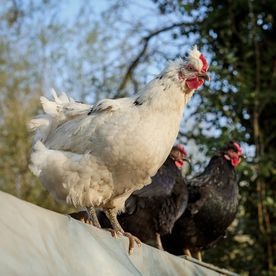
- Fed with X% of Y — e.g. "Fed with 65% maize." A named cereal has to be at least 35% of the feed formula, or 50% if it's maize.
- Extensive indoor (barn reared) — no more than 15 birds per m² indoors, and slaughtered no earlier than 56 days.
- Free range — the same 56-day minimum, slightly more room indoors at 13 birds per m², feed at least 70% cereal, and continuous daytime access to an open-air run of at least 1m² per bird for at least half of its life.
- Traditional free range — a slow-growing breed, 12 birds per m² indoors, 2m² of run each, outdoors from six weeks old, and 81 days minimum.
- Free range – total freedom — as traditional free-range, but the run is unlimited in area.
These terms apply to fresh, frozen and quick-frozen chicken, but not nuggets, sausages, and burgers. W
Watch out for other wording such as farm fresh as it tells you nothing about how the bird was reared. The same goes for farm names, pastoral photography, and the word natural.
And a producer selling fewer than 10,000 birds a year direct is outside the system altogether. That bird might carry no label at all and still be the best one in the shop.
One Thing Changed In March 2026
On 9 March 2026 the rules were replaced. Commission Regulation (EC) 543/2008, the one every article on this subject cites, was repealed and replaced by Delegated Regulation (EU) 2026/343.
Most of the changes are technical: they cut the standards cover, how water content is tested, what happens to a batch that fails inspection.
Poultry can now be sold as free-range even when the birds have been kept indoors to stop avian flu spreading. The old rule capped that housing at twelve weeks and that cap has now gone.
So free-range still describes how the farm is set up: the run, the space, the 56 days but it no longer promises that the bird went outside.

A supermarket pack of fresh chicken has to carry its country of origin. However chicken sold loose at a counter does not, unless it came from outside the EU. It must show the class, the price per weight, whether it's fresh or frozen, and the slaughterhouse registration numberm, but no origin.
So on paper the counter is required to tell you less. In practice it can tell you a great deal more. A butcher, like friend of DCS Keith Grant, has the whole chain in their head: who reared the bird, how long it took, what came in this week and what they'd bring home themselves.
Three things to ask your butcher:
- Where is it from?
- How long was it reared?
- Who's the supplier?
A good butcher will know all three without checking.
So What Does The Cheap Chicken Cost?
There's no food safety argument as the cheaper bird is as safe to eat as the more expensive one. But it's the bird carries the cost. A hen isn't a mature animal until around eighteen weeks. Any chicken killed sooner than that is till a juvenile in body and in behaviour, carrying an adult's weight on a frame that hasn't finished growing. That's what the price difference buys.
We're eating roughly 41kg of it a head each year, and volumes rose again in 2025 as beef prices pushed people across from steak and mince to chicken. Price is doing a lot of work in that decision-making.
So buy the free-range.
Not because the cheaper bird is unsafe, it isn't, but due to the animal's welfare, and the label is the only lever you have once you're standing at the shelf. And if that means chicken twice a week instead of four times a week, that's a fair trade. It'll also cost less than you'd think, because a whole bird goes a great deal further than a pack of fillets.
Getting The Most Out Of A Better Bird
Buy it whole. The same chicken costs a fraction per kilo as a whole bird compared with the same weight in fillets.
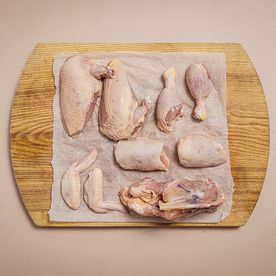
Joint it yourself. Two breasts, two thighs, two drumsticks, two wings, and the carcass. That's two meals before you've touched the bones.
Find the oysters. Two small dark muscles either side of the backbone, just above the thighs. Best bite on the bird, and most people roast them and bin them with the frame.
Pick the frame before it goes near a pot. There is more meat left on a roasted chicken than anyone expects, and while it won't plate up, it will go in a bowl, so put it aside.
Stock and soup. Carcass, an onion, a carrot, a bay leaf, a couple of peppercorns, and cold water to cover. Simmer gently for a couple of hours and never let it boil or it goes cloudy. Strain it, put the picked meat back in with a handful of red lentils or pearl barley and whatever veg is in the drawer, and simmer until it thickens.
Learn to Joint a Chicken
Everything in that list is nicely covered on our Knife Skills course: jointing a chicken, the anatomy of stocks, a pan-fried chicken supreme with roast vegetables, and a Japanese-inspired broth with soy and ginger.
€190 · One Day Course · 09:30–15:00 · Saturday 14th November 2026
We explore everything you need to know about your knife — how to hold it, how to look after it, and the techniques to master: dicing, julienne, brunoise, chiffonade. We put those skills into action, including how to de-bone a chicken. You’re more than welcome to bring your preferred one from home, or use ours, and the tutors will go through tips on sharpening and handling along with a few other essentials. As with all our one day courses, everything builds towards a wonderful lunch and a well-earned couple of glasses of wine.
Questions before you book? Email info@dublincookeryschool.ie or call 01 210 0555. You'll find us at 2 Brookfield Terrace, Blackrock, roughly 20 minutes from the city centre and easily accessible by train or bus.
COMMON QUESTIONS
- What does free-range chicken mean on a label?
- Free-range is a legally defined term under EU marketing standards. To use it, birds must have continuous daytime access to an open-air run of at least one square metre per bird for at least half their lives, no more than 13 birds per square metre indoors, feed that is at least 70% cereal, and no slaughter before 56 days. That 56-day minimum is not unique to free-range: extensive indoor, sold as barn reared, also applies. What free-range adds is the size of the run. Traditional free-range goes further again: a slow-growing breed, two square metres of run per bird and a minimum of 81 days. A chicken carrying none of these terms typically reaches slaughter weight in around five to six weeks.
- Is free-range chicken better than regular chicken?
- What free-range guarantees is specific and limited: outdoor access for at least half the bird's life, a little more room indoors, and no slaughter before 56 days. It is not a food safety claim, and chicken reared not free-range is safe to eat. Whether the extra cost is worth it is a judgement about animal welfare and about how much you're willing to pay for a slower-grown bird.
- What should I ask a butcher when buying chicken?
- Ask where is the bird reared, how long was it reared for, and who supplies it. A butcher who knows their supply chain will answer all three questions off the top of their head. This matters more at a counter than you'd expect, because chicken sold loose isn't legally required to display its country of origin unless it came from outside the EU.
- Do the lighting rules apply for a chicken's whole life?
- No. Under EU broiler/poultry shed welfare law how long a chicken remains in darkness and allowed to sleep runs from seven days after the chicks are placed in the house until three days before slaughter. Outside those dates there is no minimum dark period, so birds in their first week can be kept under continuous light. Other welfare requirements do apply throughout, including stocking density limits, litter, ventilation, access to feed and water, inspection at least twice a day, and a minimum light level of 20 lux at bird eye level during lit periods. The directive does not give a reason for the first-week exemption.
- Does 'free-range' apply to chicken nuggets and burgers?
- No. EU poultry meat marketing standards doesn't cover poultry meat preparations, which includes nuggets, burgers and sausages. The defined terms apply to fresh, frozen and quick-frozen poultry meat.