Your Recipes Aren't the Problem. Your Relationship With Them Is.
23rd April 2026

There's a version of creative cooking that lives on social media: elaborate, photogenic, the kind that involves seventeen steps, a sous vide machine, and at least one ingredient you've never heard of. That's not what we're talking about.
The kind of creative cooking that really changes how you cook at home is quieter than that. It's looking at the tin of lentils in the cupboard and knowing what to do with it. It's understanding why a dish tastes flat and being able to fix it, not by asking Gemini, but because you already know what's missing. It's cooking a curry base that works three ways depending on who's coming to dinner and what they can eat.
This week, two dates landed close together: UN World Day of Creativity & Innovation on 21 April, and Earth Day on 22 April. Neither has anything obvious to do with cooking, but for us they overlapped and had us thinking about how the cook who wastes least is usually the cook who thinks most creatively. Those two things can feed each other in ways a recipe will never teach you.
Creativity isn't just a talent. It's also a skill
The research on creativity is consistent on this: it's not a fixed trait. It develops through practice, exposure, and through working within constraints. A blank page is harder to write on than one with a prompt. A sparse fridge is more daunting than one full to bursting.
Home cooks who feel uncreative in the kitchen are often those who feel comfortable just following a recipe exactly. But if you never venture outside the recipe book, it can become a cage stopping you from progressing in the kitchen.
The shift happens when you start treating recipes as starting points or inspiration rather than scripts. When you understand why a recipe works — what the fat is doing, what the acid is balancing, what happens to the texture if you swap the protein — you stop needing the recipe to tell you what to do next.
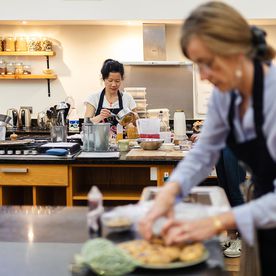
The more you know, the more confidence you build. The more you cook, the more you know and the more you can adapt in the kitchen. This is the whole idea behind our Become a Better Cook course.
Five days, all levels, built around dishes that have what our tutors call a chameleon quality — once you understand how they work, you can adapt them, season them differently, cook them for whoever is at your table. The next course date is 11 May.
The Thursday Evening Test
One of the most honest tests of cooking confidence is this: stand in front of your fridge on a Thursday evening, look at what's left from the week, and make something you'd be proud to serve up to someone else.
A lot of the time once you get to Thursday your carefully designed meal plan is out the window: something went off quicker than you thought, someone ate the leftovers you were planning to heat up - we’ve all been there. This is when most people reach for the phone to call in a takeaway, because they have no idea what to make now that the meal plan has reached it's last legs.
Its not because the ingredients aren't there, but because they haven't yet built the instinct for working with what they have. That instinct comes from understanding what ingredients are actually doing in a dish, rather than just what order to add them in.
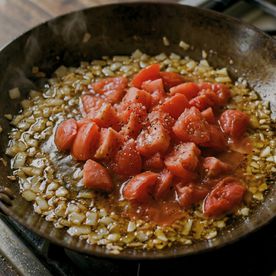
Take a sofrito — generally aromatics (onion, carrot, celery) cooked down slowly in olive oil until they become sweetly flavoured. That base sits underneath half the dishes in Italian, French, Spanish, and North African cooking. Add smoked paprika and saffron and you're heading towards a Spanish braise. Add cumin, coriander, and a tin of chickpeas and you're somewhere in North Africa. Add dried chilli and a splash of red wine and the same base becomes the foundation of an Italian meat ragu. Same technique, same twenty minutes of work, completely different results depending on what you reach for next.
Learn one base like this properly and you have something to build on for years. You know why it works, so you can go beyond what the recipe tells you.
Cooking for the People at Your Table
One of the most common reasons home cooks feel stuck is dietary requirements. Someone is dairy-free, someone doesn't eat red meat, a third has gone gluten-free since last Christmas. Adapting a dish you know well to account for all of that can feel like starting from scratch every time. It rarely is.
Dairy in a sauce provides fat and richness. Coconut milk or good olive oil can usually do the same job — they behave differently, but the function is the same. Gluten in a coating provides texture and crunch. Ground almonds, polenta, or chickpea flour each work as alternatives, though the method may need a small adjustment to account for how they absorb heat. Meat as the centrepiece provides fat, protein, and depth of flavour. Legumes can carry that role, but they need more help with seasoning and acid to get there — they absorb flavour differently and reward patience.
The point is not that there's a clean swap for everything, because there isn't. The point is that once you understand what an ingredient is doing, you can make a sensible decision about what might do it instead. That's what creative cooking looks like on a Tuesday night in a real kitchen.
Constraints Are the Point
Here's something that sounds counterintuitive: the cooks who develop the most confidence are often the ones who spent time working with less elements. When everything is available — every ingredient, every tool, every technique — you don't have to make decisions. You follow the path. When something is missing, you have to think and thinking is where cooking skills really develop.
This is directly relevant to how most Irish home cooks are shopping right now. Food prices have been running well above general inflation for the past two years, and the gap between wanting to cook better and having the budget to experiment with premium ingredients is real. But getting more from less is easy when you know how.
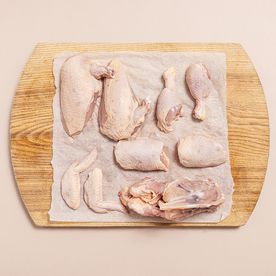
Think about it this way.
A whole fresh chicken costs around €7.50 for roughly 2kg. From that, you get two breasts, two thighs, two wings, and a carcass. Buy two part-boned chicken breasts instead and you'll spend around €6 — and that's all you get. Break down the whole bird yourself and you've got the breasts for one meal, the thighs and wings for another, and the carcass to simmer into a broth that becomes the base for a sauce or soup that a stock cube simply won't replicate.
Same budget, three meals, and the best of the flavour — which lives in the bones — hasn't been thrown away before you even started cooking.
Cooking creatively isn't a personality type and it's not something you either have or you haven't. It's a set of decisions — about what you buy, how you break it down, what you do with what's left — that gets easier every time you make them. The more you cook like this, the less you need a recipe to tell you what to do next. That's what we specialise at here at Dublin Cookery School.
come cook with us
The Summer Curries class is one evening, €95, and you'll leave with four curries and a couple of sides that you can cook from scratch at home — and, more usefully, the understanding to adapt each one. It runs on 20 May and 23 June at Dublin Cookery School in Blackrock. All levels. No prior experience needed.
If you want to go further, the Become a Better Cook course starts 11 May - five days, all levels welcome, and lunch included each day. It's built around the idea that the best thing a cookery course can give you isn't just twenty-five new recipes — it's the confidence to make those recipes your own. Students who've done it tend to say the same thing: they leave cooking differently, not just cooking more.
FRequently Asked questions
- What does it mean to cook creatively?
- Cooking creatively means working confidently with what you have rather than following a recipe to the letter. It comes down to understanding why dishes work — the role of fat, acid, heat, and seasoning — so you can adapt and cook for whoever is at your table.
- How do I become more creative in the kitchen?
- Understand technique rather than memorise recipes. Once you know what an ingredient is doing in a dish, you can make informed decisions about adapting it. Cooking the same dishes repeatedly until you stop needing to look at the recipe, working with seasonal produce, and deliberately cooking with constraints all build this kind of confidence faster than trying something new every time.
- Can I cook creatively on a tight budget?
- Yes — budget cooking often produces the most creative results. Learning to build flavour from inexpensive ingredients like legumes, tinned fish, spices, and seasonal vegetables is a core cooking skill. A constraint tends to sharpen decision-making in the kitchen, not limit it.
- How do I adapt recipes for dietary requirements?
- Start with what the ingredient is doing in the dish, not what it is. Dairy provides fat and richness — coconut milk or olive oil can often do the same job. Gluten provides texture — ground almonds or polenta can substitute, with a small adjustment to method. Meat provides fat, protein, and depth — legumes can carry that role if you season and finish them properly. Function first, swap second.
- What are useful no-cook ingredients to keep in the kitchen?
- Quality tinned fish, a sharp hard cheese, good olive oil, tinned legumes, nuts & seeds, whole spices, capers, and preserved lemons. None of these need heat to deliver flavour and all of them extend a meal significantly — practically useful for reducing energy use without compromising what ends up on the plate.
- What is the Become a Better Cook course at Dublin Cookery School?
- A five-day hands-on course for cooks of all levels. Each day is built around a different menu with an emphasis on adaptability — dishes designed to be made your own, not just repeated. It runs at our cookery school in Blackrock, next date 11 May 2026, and a wonderful lunch each day is included. Find out more →
- Does Dublin Cookery School teach creative cooking techniques?
- Every class focuses on the skill behind the dish rather than just the recipe — which is what builds genuine confidence over time. The Summer Curries and Become a Better Cook are only just two of our many classes that are a good entry point for this.