The Most Dangerous Room in Your House Is the One You Use Every Day
28th April 2026

Nobody talks about kitchen safety the way they talk about road safety. There are no awareness campaigns on the school run, no mandatory modules in secondary school, no national conversation. Yet the kitchen is where accidents quietly happen — burns, cuts, food poisoning from raw chicken that got from the worktop to the phone screen without a handwash in between.
Today is the UN World Day for Safety & Health at Work. Most of the coverage will focus on construction sites and factories. For those that work in the kitchen? We want to talk about the room where your family eats every night.
What the Research Actually Shows About Irish Kitchen Safety
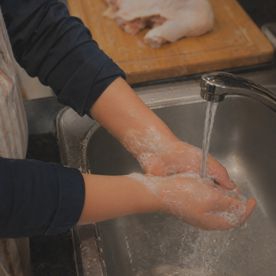
In May 2024, Safefood published research based on 520 adults across the island of Ireland. The findings are specific, measurable, and unsettling.
One in three participants did not wash their hands after handling raw chicken before picking up a smart device. Nearly three quarters — 74% — failed to wash their hands after handling raw eggs before touching their phone. Safefood's Director of Food Safety confirmed that food poisoning bacteria including Salmonella and E. coli can survive on a device screen for more than 24 hours.
That is not a hygiene lecture. That is a cross-contamination chain that runs from raw chicken on the board to the child who picks up the phone to show you something at dinner.
Why this matters for parents
Food hygiene habits are formed through repetition. If a teenager learns to cook without being taught to wash their hands after raw protein — every time, not occasionally — that gap travels with them into adult life. It is not carelessness. It is a gap in what they were taught.
Safe Cooking Techniques: Beyond Food Hygiene
Food safety is only one part of what keeps a teenager safe in the kitchen. Physical hazards — knives, heat, burns — are the other side of the equation.
Global kitchen safety data (drawn from US-based research, used here for scale rather than as Irish-specific statistics) suggests that over 60% of kitchen injuries are preventable with proper technique, and that trained household members show significantly fewer accidents.
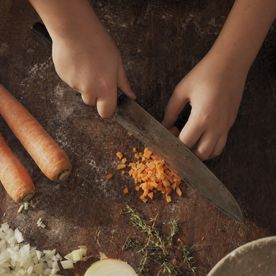
The mechanism is straightforward: confident, practised handling reduces the hesitation and improvisation where most injuries occur.
A sharp knife used correctly is considerably safer than a blunt one forced through food. A teenager who has been taught how to hold a knife, how to use a claw grip, and how to cut away from themselves is far less likely to slip than one who has never been shown.
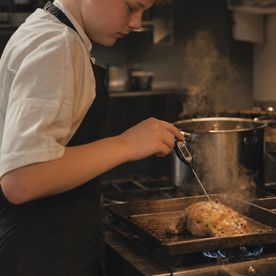
The same logic applies to heat. Knowing which pan handles to turn inward, how to test oil temperature safely, and what to do if something catches fire are not advanced skills. They are basic kitchen literacy.
The Confidence Gap
A cross-sectional study published in the International Journal of Behavioural Nutrition and Physical Activity examined 1,049 adults from a nationally representative sample across Northern Ireland and the Republic. It found that people who learned cooking skills before the age of 18 showed significantly greater confidence in the kitchen, better food safety practices, more positive attitudes towards cooking, and higher diet quality compared to those who learned as adults.
The study also identified something the researchers called a "deskilling" trend. The mother remains the primary source of cooking skills in Irish households. But mothers may increasingly be unable to pass those skills on because they were never properly taught themselves. The authors concluded that alternative sources of practical cooking education, starting at an early age, are now necessary.
That is a significant finding. It is not a commentary on parenting. It is a structural observation: if the skill was not transmitted, it cannot be passed on. The chain has to be rebuilt somewhere.
The ultra-processed food connection
PwC's 2025 Irish Voice of the Consumer survey found that 57% of Irish consumers are concerned about ultra-processed foods.
If you are worried about what your teenager is eating when you are not there to cook for them, teaching them to cook real food from scratch is the most direct response available. The skill and the safety concern are the same conversation.
What Good Kitchen Safety Education Looks Like
There is a version of "kitchen safety" that is a laminated poster on a wall. Then there is the version where a teenager stands at a professional-grade board, is shown exactly how to grip a knife, practices it, and leaves able to repeat the action correctly at home.
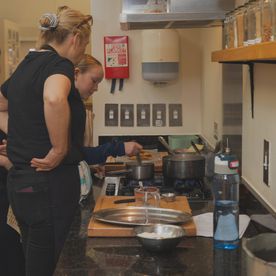
Those are not the same thing. One produces awareness. The other produces a habit.
Good structured cooking education for teenagers covers safe food handling as a matter of course — not as a separate module, but woven into every session.
Washing hands after raw protein is not presented as a rule to follow; it is demonstrated as the obvious next step in a sequence, so it becomes automatic. Covering the handle of a hot pot with a tea towel becomes a force of habit.
What to Look for In a Teen Cooking Class
When parents are choosing a cooking class for a teenager, safety is a purchase driver — not an afterthought. The practical questions worth asking before booking are:
- Supervision ratio. A professional kitchen environment with clearly defined instructor-to-student ratios is materially different from a loosely supervised group setting.
- Is food hygiene taught as a practice, not a policy? Safe handling should be demonstrated and corrected in real time, not mentioned once at the start of the session.
- Are knife skills taught from first principles? Correct grip, correct technique, correct posture. These are the things that prevent cuts.
- Does the class build towards independent cooking? The goal is not to produce a teenager who can cook in a supervised environment once. It is to produce one who can cook safely at home on their own.
How DCS Approaches Teen Kitchen Safety
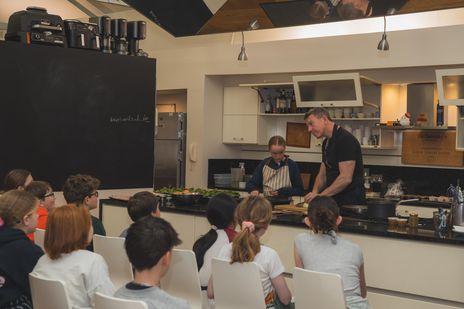
At Dublin Cookery School, our Growing Gourmet programme for teenagers is built in a professional teaching kitchen, with structured supervision and a curriculum that covers technique from the start. That includes knife skills taught correctly, food hygiene practiced throughout every session, and heat and fire safety as standard.
Teenagers leave the programme able to plan a meal, handle raw ingredients safely, cook at the correct temperatures, clean up properly, and repeat the process without supervision. Those outcomes are not incidental to the cooking. This is what cooking is about.
Parents tell us consistently that what surprises them is not just all the wonderful things their teenager produced in the kitchen — it is how they moved around it. Confident, careful, competent.
Frequently Asked Questions
- How can I keep my teen safe in the kitchen?
- Teach safe cooking techniques before they cook independently: correct knife handling, proper handwashing after raw protein, temperature awareness, and fire safety. Structured cooking education in a supervised professional environment is the most reliable way to build these habits correctly from the start.
- What is HACCP and why does it matter at home?
- HACCP (Hazard Analysis and Critical Control Points) is the food safety system used in professional kitchens across Ireland and the EU. At home, its practical application means: controlling food temperatures, preventing cross-contamination between raw and ready-to-eat food, practising personal hygiene throughout cooking, storing food correctly, and keeping surfaces and equipment clean. These habits, learned early, are the foundation of safe, confident cooking.
- At what age should teenagers learn to cook?
- Research from a nationally representative study across Northern Ireland and the Republic found that learning cooking skills before 18 produces significantly better outcomes than adult learning: more confidence, better food safety practices, and higher diet quality. The earlier the foundation is built, the more reliably the habits form.
- Is it safe for a teenager to handle raw chicken and eggs?
- Yes, with proper training. Safefood's 2024 Irish research found that 1 in 3 adults transferred bacteria from raw chicken to smart devices by not washing their hands between handling. The food is not the hazard — the gap in procedure is. A teenager taught to wash their hands immediately after raw protein contact, every time, has the skill.