Lúnasa: Ireland's Harvest Starts in August. Here's What to Cook.
19th August 2026
If you want to know what to cook at home in August in Ireland, the answer is at least 2,000 years old, dating back to pre-Christian Ireland, or 900 years old once it was absorbed into a christian tradition. Traditionally this meant the first new potatoes, freshly-cured bacon and white cabbage, with fraughans for dessert. That was the meal Irish households were expected to put on the table at Lughnasadh, the festival that opens the harvest on 1st August.
This turns a story about relief from hunger into a story about gratitude. Lúnasa was the first proper feed after the hungry weeks of July, when the old potatoes were gone or had gone bad and the new ones weren't coming until August. The end-of-harvest festival is Samhain (from sunset on 31st October to sunset on 1st November).

What is Lúnasa, and why does it start the harvest?
Lúnasa (Lughnasadh, Lughnasa) falls on 1st August, the cross-quarter point between the summer solstice and the autumn equinox. Lúnasa is still the modern Irish word for the month.
The name is a combination of “Lug” (the god Lugh) and násad (an assembly). In medieval Irish literature, Lugh founds the festival as a funeral feast and games in remembrance of his foster-mother Tailtiu, who died of exhaustion clearing the plains of Ireland for farming. That's mythology rather than archaeology, but it's a good story.
Here's the part that makes it different from the other ‘quarter’ days, its a festival that's still celebrated in some localities today. Máire MacNeill's The Festival of Lughnasa (Oxford, 1962) tracked the festival alive at hundreds of sites into the nineteenth and twentieth centuries, and found more than eighty local names for the one day.
You are probably celebrating it already. Puck Fair crowns a wild mountain goat King Puck in the town of Killorglin between 10th-12th August, and the Ould Lammas Fair in Ballycastle still sells dulse and yellowman on the last Monday and Tuesday of the month.
The ‘first-fruits’ meal: new potatoes, bacon & white cabbage
The folklore record is surprisingly consistent on what was eaten. New potatoes, fresh bacon, white cabbage, and a bread or oatcakes from the newly harvested grain of the season. A farmer who couldn't get the ‘first digging’ onto the table by Garland Sunday (the last Sunday of July) faced genuine social shame, because it meant he'd managed the ground badly.
That is the most Irish plate imaginable but one rarely championed at home. Cooked badly it deserves its scorn but cooked properly it's one of the best things you'll eat all year. The difference? The technique.
- Buy potatoes fresh from the ground. New season Irish potatoes have thin, scuffed skins that rub off under your thumb. Scrub, don't peel. Start them in cold, well-salted water with a sprig of mint and take them off the heat while a knife still meets slight resistance.
- Treat the bacon like a joint, not a rasher. A piece of collar simmered gently, then finished in a hot oven with a glaze, is a different food to the greyish meat that usually comes to mind when you see “Bacon and Cabbage” on a menu.
- Stop boiling cabbage. We cannot stress this enough. Shred it finely, cook it fast in a little butter with a splash of the bacon water, or a little stock, a good pinch or two of black pepper, and take it off while it still has bite. No one will thank you for serving soggy cabbage.
- Shop locally. Where you buy it matters as much as what you do with it — our guide to shopping local without overspending covers the butcher, the greengrocer, and the market stall.
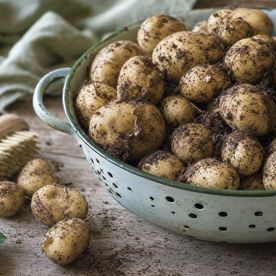
Fun Fact: Potatoes only reached Ireland in the 1600’s. The first-fruits idea is ancient and the potato is a late and 'recent' arrival to it.
The tradition adapted to a new ingredient, which is a fair argument for letting it adapt again.
The point is not the potato but eating whatever’s ready, and this month that's courgettes, tomatoes and beans as much as spuds.
Fraughans: the berry with THeir own Sunday
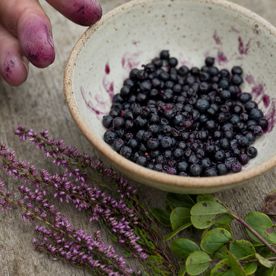
The other Lúnasa food is the fraughan, the wild bilberry (Vaccinium myrtillus), from fraoch, heather, because that's what its growing beside on bogland and hillside. They ripen from late July and they gave the day one of its most common names: Fraughan Sunday, or Bilberry Sunday.
People climbed the hill, picked them, ate most of them on the spot and carried the rest home for anyone too old or too ill to make the walk. Boys strung them into bracelets for the girls they were courting. At the Lúnasa dance, one girl was chosen to bake the bilberry cake, which was an honour rather than a chore.
They're smaller and sharper than a blueberry and they stain everything. Jam, syrup, wine, tarts and cakes are all documented. For the cake, fold them through a plain sponge, sharp fruit against a sweet batter.
And there was a ‘stop’ rule: nothing picked after the first Sunday in August, because Crom Dubh (the Crooked One) and the fairies had spat on them. Ireland has a lot of these deadlines but we’re still braving the fairies wrath and eating them while the going is good.
If you can't get to a hillside, the technique carries straight over to whatever fruit is in front of you in August (blackberries or damsons are good candidates) .
Five things most Lúnasa articles get wrong
- Lugh was not a sun god. He's the samildánach, the many-skilled one. The sun-god framing is a Victorian invention that modern scholarship rejects, and roughly half the copy online still repeats it.
- It isn't a thanksgiving harvest festival. It's the beginning of the harvest and Samhain closes it. Its a relief from hunger, not a celebration of abundance.
- The Lammas loaf isn't Irish. Hlāfmæsse, loaf-mass, is Anglo-Saxon, from a wheat-growing country. Ireland grew oats and barley, and the Irish first-fruits meal featured what was available here (eg. new potatoes, fraughans).
- 1st August is the date, but the Sunday is the day. Nearly all the folk practice sits on the nearest Sunday.
- The potato is a newcomer. See above - the tradition adapts as the seasons do.
Learn to cook the seasons
4 Week Essential Skills Course
€3,950 | Monday–Friday, 09:30–16:30 | Starts 7th September 2026
If this is the way you want to cook year-round rather than for one week in August, our 4 Week Essential Skills Course gives you the knowledge to adapt your cooking to what's in season. Twenty days, hands-on, covering knife skills, stocks & sauces, vegetables, grains & pasta, meat & butchery, fish & shellfish, pastry & breads, spices & herbs, fermentation & global flavours, contrasting methods of cooking, and culminating in a pop-up restaurant night for entertaining and hosting your family and friends.
-
I can't recommend it enough
The course more than met my expectations. The school can be summarised in 3 words: professionalism, passion and most importantly, generosity. It was one of the best life experiences I've had.
Sandra: 4 Weeks Essential Skills Course, Jan 2025