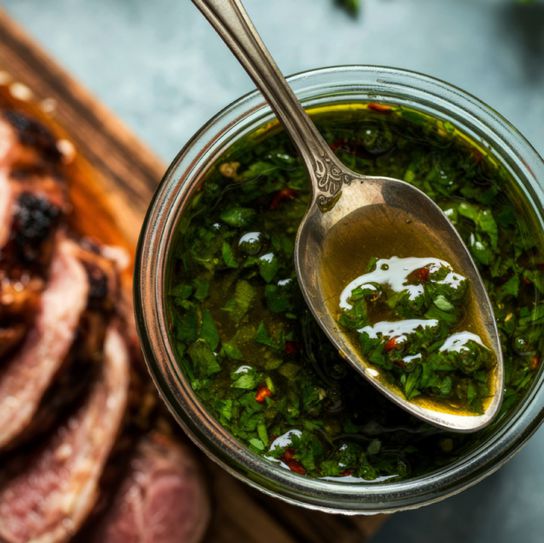
Smoked Chimichurri (Em Brasa)
Most chimichurri is made in five minutes and eaten the same day.
This one is different. Matheus — who spent seven years cooking over open fire in Brazil before joining us at Dublin Cookery School — builds his version on smoke, char, and time.
The technique is called em brasa, meaning over the coals. An onion goes into the embers whole, skin-on. The herbs are charred directly over flame until half of them are blackened. The butter is smoked by dipping a live coal into it to absorb the flavour. Then everything is brought together slowly, finished with extra virgin olive oil.
The result keeps on a shelf (not in the fridge or freezer) and deepens over weeks, months and even years! It goes on steak, on bread, on roasted vegetables. It goes on everything.
To prepare the Smoked Chimichurri (Em Brasa)
Serves: Makes 1 medium jar
Time: 40 minutes, plus ageing time
Skill level: Intermediate
Equipment: Barbecue or open fire, coffee filter, small saucepan, kilner jar
- Bury your onion
- Place the whole onion, skin-on, directly into the hot embers — this is the rescoldo technique, cooking in residual heat rather than direct flame. How long it needs depends on how you plan to use the chimichurri. If you're ageing it for several days before eating, 20 minutes is enough — a little bite left in the onion works in its favour. If you want it ready to eat straight away, leave it until completely tender.
- Char your herbs
- Set aside roughly a quarter of the fresh herbs - coriander, parsley and oregano, stems and all - and chop. These uncharred herbs folded in at the end will add a brightness to the sauce. Take the remainder of the herbs and char them over a direct flame. You're looking for about 50% of the herb to be properly blackened. This is not an accident; the char is where the distinct smoky aromatic character comes from. Once charred, roughly chop all three bunches together.
- Smoke the butter
- Place the unsalted butter and whole garlic cloves into a small saucepan and set it directly over the hot coals. Once the butter has melted fully, use a pair of tongs to pick out one glowing coal from the fire and dip it into the butter for 3–4 seconds to properly enrobe it. Place it back on the barbecue to light on fire, then submerge it in the butter again. Return to the fire a second time, then submerge in the butter for a third and final time. Strain the entire contents of the melted butter through a coffee filter — this removes the coal particles and leaves you with a clean, deeply smoked butter.
- Bring everything together
- Place the chopped charred herbs and the freshly chopped herbs into a bowl. Take the outer skin off the onion, discard, and cut the onion into quarters, separating out it's layers, add to the bowl. Drizzle in the smoked butter a little at a time, tasting as you go — it is strong and you want balance, not dominance. Add approx. 400ml of olive oil, working it in gradually. Finish with a pinch of dried chilli flakes, season well, and stir to combine. Add a squeeze of lemon juice just before serving if you're pairing it with pork.
- Store and age
- Transfer everything to a clean kilner jar, top up with extra virgin olive oil, white wine vinegar, and place it on a shelf (keep it out of the fridge and freezer). The flavour develops over time — the oil, acid, and charred herbs continue to work together. It gets better after a few days, better again after a week. Matheus has kept his going for the better part of a year.
Ingredients
For the Onion
1 whole onion, skin-on
For the Herbs
1 small bunch fresh coriander (including stems)
1 small bunch fresh flat-leaf parsley (including stems)
1 small bunch fresh oregano (including stems)
For the Smoked Butter
100g unsalted butter
2 whole garlic cloves
To Finish
400ml extra virgin olive oil
Pinch of dried chilli flakes
2 tbsp white wine vinegar
Salt and pepper
Squeeze of lemon juice (optional — more common when serving with pork)
Frequently Asked Questions
- Do I need a barbecue to make this?
- You need some form of live fire — a barbecue, a fire pit, or a gas hob for the herb charring step. The coal-smoking technique for the butter specifically requires real embers. It can't be replicated on an electric hob.
- What does em brasa mean?
- Em brasa is Portuguese for "over the coals" or "on the embers." It refers to the method of cooking directly in or over fire rather than on a grill grate above it.
- Can I use dried herbs instead of fresh?
- No. The charring technique only works on fresh herbs — dried herbs have no moisture and will simply burn rather than char. Fresh is essential here.
- How long does chimichurri keep?
- This version can be kept for several weeks, up to a year and beyond, on a shelf — not in the fridge or freezer — and improves over time. Keep it in a clean sealed jar and ensure the herbs are fully submerged in extra virgin olive oil.
- What do you serve smoked chimichurri with?
- It goes on almost anything. Steak and other barbecued meats are the classic pairing. It also works well on roasted vegetables, grilled fish, crusty bread, and eggs. Add touch of lemon juice if serving with pork.
- What is Quebracho charcoal?
- Quebracho (white holm oak) is a South American hardwood, typically from Paraguay, and is used traditionally in Argentine and Brazilian open fire cooking. It's 100% completely natural and we use a sustainable version at the cookery school. It burns hotter and longer than most standard European charcoal and adds its own subtle mild smokey flavour. It's available from specialist BBQ suppliers in Ireland.
- Is this the same chimichurri served at Dublin Cookery School?
- This is Matheus's personal recipe, demonstrated as part of our Beyond the Recipe video series. For the full demo, watch the video on our YouTube channel.
Join us at our cookery school to learn how to cook similar dishes
- Summer BBQ: Practical & Hands-On One Day Course
Give a gift
Our gift vouchers are the perfect present for any food lover
Buy a voucher